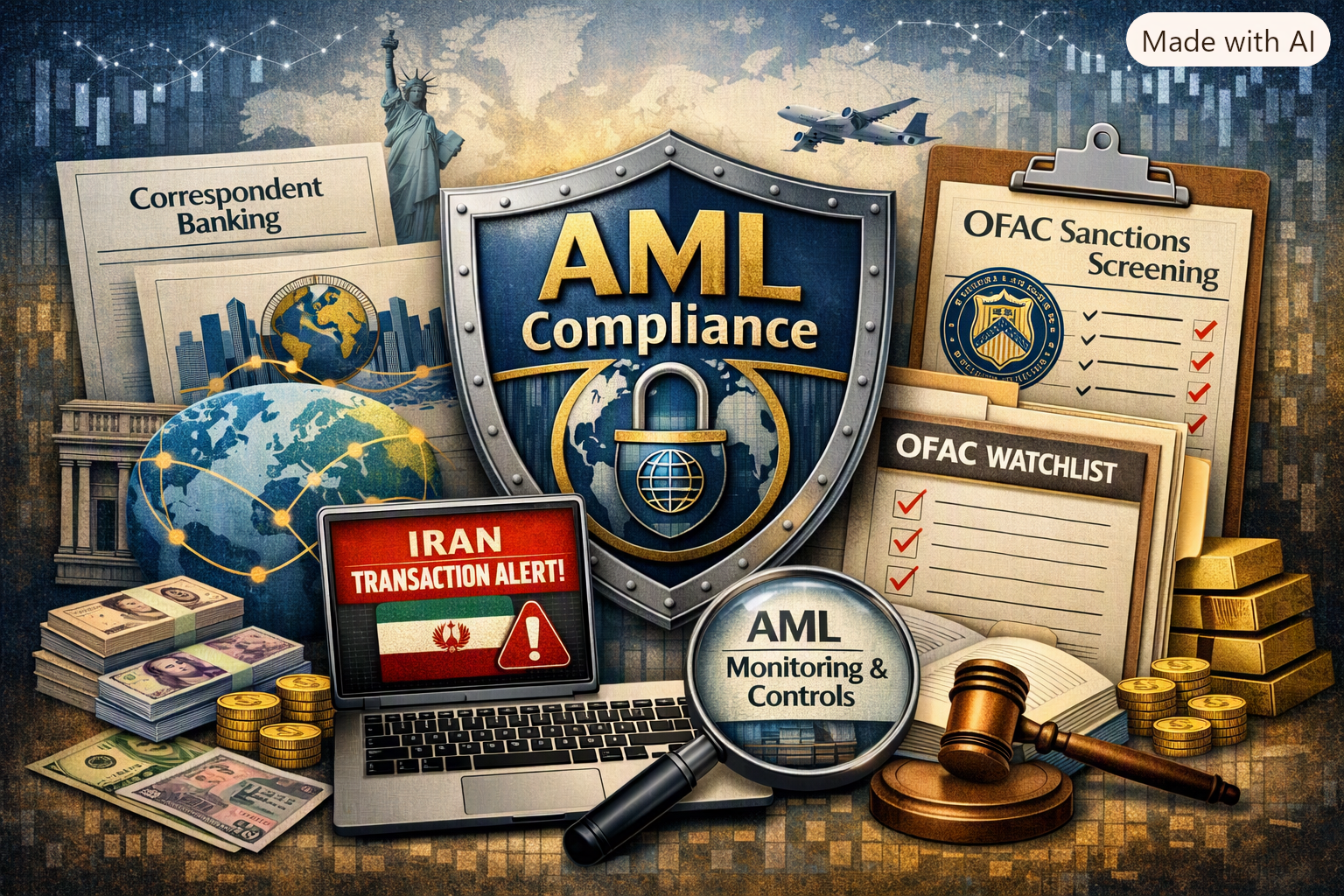
The U.S. Treasury Department’s Office of Foreign Assets Control (OFAC) has updated its Iran sanctions guidance to warn foreign financial institutions about potential sanctions risks associated with certain Iran-related activities.
The update, dated October 5, 2026, forms part of the broader Operation Economic Outcast initiative.
What OFAC’s update says
OFAC’s guidance addresses foreign financial institutions that continue to conduct business with Iran or Iran’s financial sector.
The guidance explains circumstances under which the U.S. Treasury Department may impose restrictions on U.S. correspondent or payable-through accounts where applicable legal requirements are met.
This creates an important sanctions-compliance consideration for international banks with direct or indirect exposure to Iran-related transactions.
Why correspondent banking matters
Correspondent banking allows financial institutions to provide payment and other banking services to customers of another financial institution.
Because international payments frequently pass through correspondent relationships, sanctions exposure can extend beyond the original customer relationship.
Banks therefore need effective controls covering customers, counterparties, payment instructions and relevant jurisdictions.
Sanctions risk and transaction monitoring
Sanctions screening is one part of the control framework.
Transaction monitoring can also help identify unusual payment patterns that may require further investigation.
For example, institutions may assess whether payment activity is consistent with customer profiles, known business relationships and applicable sanctions restrictions.
Any investigation should be based on the institution’s applicable legal and regulatory requirements.
Importance for foreign banks
The update is particularly relevant to financial institutions outside the United States.
International banks need to understand which U.S. sanctions obligations may apply to their activities and how correspondent-account exposure could be affected.
This requires close coordination between sanctions, AML, legal and correspondent-banking teams.
KYC implications
KYC information can help financial institutions understand the parties involved in a transaction.
Accurate information about beneficial ownership, business activity, geographic exposure and counterparties can support sanctions-risk assessments.
This is particularly important where transactions involve complex corporate structures or multiple intermediaries.
Compliance governance
Senior management should ensure that sanctions risks are incorporated into the institution’s broader financial-crime risk framework.
Policies should clearly define responsibilities for screening, alert investigation, escalation and reporting.
Training is also important because front-line employees and payment teams may encounter transactions requiring sanctions review.
Key takeaways
- OFAC updated Iran-related sanctions guidance on October 5.
- Foreign financial institutions conducting Iran-related business may face sanctions risks.
- Correspondent and payable-through accounts are particularly relevant.
- Sanctions screening should operate alongside appropriate transaction controls.
- KYC information can help identify relevant customers and counterparties.
- International banks should coordinate sanctions, AML and legal functions.
The update demonstrates why sanctions compliance cannot be isolated from broader financial-crime controls, particularly for institutions involved in international and correspondent banking.